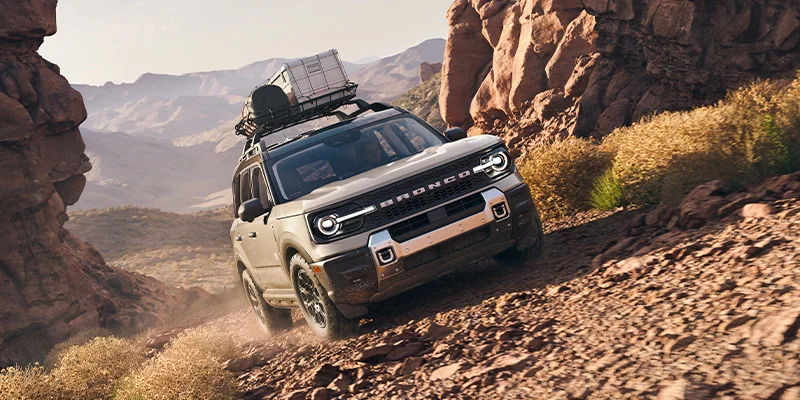
If you plan to take your Ford SUV or pickup truck off paved roads, then it's important to use safety and engineering features that support stable handling. Ford Hill Descent Control is a key component of the Ford Co-Pilot 360 safety suite of driver assistance technology that enhances your off-road safety so you can plan your next adventure with more confidence. Hill Descent Control works by controlling your downhill travel speed with automatic brake application. This system allows the driver to select a travel speed for downhill driving. When the system is activated, the brakes will automatically pump to prevent your vehicle from speeding down a hill. This feature can be activated during low-speed travel below 21 MPH and will automatically disengage when the vehicle travels above 37 MPH. How to Use the System Drivers can activate Hill Descent Control by pushing a button on the central console. Setting the downhill driving speed can be done by using the steering wheel cruise control switches, or drivers can use the gas and brake pedals. The brake system can override the Hill Descent Control system in case of an emergency. When to Use Ford Hill Descent Control Hill Descent Control is specifically designed for off-road travel, such as when you are descending a steep hill on rough terrain. Because this system regulates your downhill travel speed with autonomous braking, it allows you to focus more on controlling the steering direction of your Ford so you can ease around obstacles in your path or keep your vehicle straight on narrow trails. However, you can also activate this system on paved roads, such as if you are driving in a hilly area in the city or the suburbs. This system will perform with the same brake regulation pattern to maintain a slow and controlled hill descent on ordinary tarmac. This system may even be particularly helpful to control your downhill descent speed during inclement weather. Can This System Be Used While Trailering? If you are hauling a heavy load with a model like the 2025 Ford F-Series, Hill Descent Control can be a boon to your vehicle handling. Traveling downhill with a heavy trailer or camper can be tricky in both on-road and off-road driving environments. When Hill Descent Control is activated, you can feel more at ease driving down a slope with a fully loaded trailer, since this system maintains your set travel speed and prevents the heavy load from pushing your truck downhill faster. Hill Descent Control is a crucial safety feature for off-road driving at moderate speeds, but it can also be used to improve downhill vehicle control when a trailer is attached. Try out this system during a test drive at Bob Maxey Ford (Detroit) in Detroit, MI. FAQs About Our Ford Vehicles and Services Q1. How does Ford's Hill Descent Control improve off-road driving? Ford's available Hill Descent Control helps maintain a controlled vehicle speed when traveling down steep grades, allowing drivers to concentrate on steering and navigating challenging terrain. The system automatically manages braking when operating within its supported conditions. Drivers interested in learning about Ford's available off-road technologies can visit Bob Maxey Ford in Detroit, MI, to explore models and features designed for different driving environments. Q2. Where can I find auto repair near Detroit, MI, for my Ford's off-road driving systems? Drivers searching for auto repair near Detroit, MI, can contact the Bob Maxey Ford service department for assistance with Ford vehicle maintenance and diagnostics. If your Hill Descent Control system displays a warning or does not operate as expected, our service team can inspect the vehicle and recommend appropriate next steps. The service center also provides brake inspections, tire maintenance, and other automotive services. Q3. How do I find the best Ford dealer near me for off-road vehicle maintenance? If you're looking for the best Ford dealer near me for off-road vehicle maintenance, consider Bob Maxey Ford in Detroit, MI. Our dealership provides access to Ford maintenance services, genuine Ford parts, and technicians familiar with Ford vehicle systems. Regular inspections of brakes, tires, suspension components, and other equipment can help identify maintenance needs following demanding off-road driving.